
AI Analytics is the attribution layer that turns AI visibility into measurable revenue
You can be cited in 100% of category queries and still not know if any of it drove a deal. The platforms ranking your brand inside ChatGPT, Claude, Perplexity and Gemini count mentions — not money. AI Analytics closes the gap: from AI mention → click → page view → conversion event → revenue attribution. It's the layer that makes a CFO sign off on the AI SEO budget.
7-day trial · no credit card · cancel anytime
Tracking mentions, citations and share of voice is the easy part. The hard part is connecting those mentions to actual revenue. Today, only 9% of marketers say they can measure all the metrics that matter, and 49% name the impact of AI on pipeline or revenue as one of their hardest measurement problems (Semrush, The Operational Gap, June 2026, n=481). That gap — between visibility and attributable revenue — is what AI Analytics solves. Everything else is reporting on top of an unverified assumption.
Why pure visibility fails as a justification framework
Most AI SEO platforms in 2026 ship with the same dashboard skeleton: mentions counted, citations grouped, share of voice computed, sentiment scored, competitors benchmarked. The numbers go up. The reports look impressive. The CMO presents them quarterly.
And then the CFO asks: "how much revenue did this generate?"
The room goes quiet.
This is the attribution gap — the structural reason 78% of marketers surveyed in 2026 report their SEO and AI search efforts are not fully integrated across strategy, execution and reporting, with revenue attribution and AI-answer visibility flagged as the two hardest-to-measure metrics. The gap exists because the AI SEO discipline grew from a measurement-first heritage: count what you can see, ship dashboards, scale tracking. Revenue attribution was always the hard problem, so it was left for "later."
AI traffic is dark by design
Users prompted by ChatGPT to visit your site arrive with sparse referrer data. GA4 puts most of it into "Direct / None" — the same bucket as bookmarks and dark social. Visibility data and traffic data become disconnected.
Conversion windows are longer
A user who asks Claude "best CRM for mid-market" may convert 6 weeks later via a Google search of your brand name. Standard 7-day attribution windows miss the influence entirely.
Multi-engine needs deduplication
A user citing your brand in ChatGPT, validating in Perplexity, then converting via Google needs a unified attribution model — not three separate citation logs.
The cumulative effect
A brand that improved AI citation rate from 12% to 38% over 6 months may show essentially flat reported revenue from "AI source" in their dashboards. The traffic and revenue exist — they're just attributed elsewhere. The dashboards lie by omission.
What is AI Analytics?
AI Analytics is the discipline of measuring how AI-driven visibility translates into traffic, engagement, conversion events and revenue — and attributing that revenue back to specific AI engines, prompts and content pieces with verifiable methodology.
It is the attribution layer of AI SEO. GEO produces. LLM SEO enables. Brand Tracking observes. AI Analytics justifies.
Three operational distinctions matter:
AI Analytics is not "Google Analytics 4 with an AI filter." GA4 captures clicks but not the prompt that originated them. AI Analytics integrates upstream context (which engine, which prompt, which citation source) with downstream behavior (page views, events, conversions, revenue).
AI Analytics is not "AI dashboards." Dashboards report what happened. Analytics explains why and connects to action. The distinction matters because pure dashboards optimize for executive presentation, not for ROI justification.
AI Analytics is not single-engine. A complete attribution model deduplicates user journeys across ChatGPT, Claude, Perplexity, Gemini, Google AI Overview and Google SERP — not just one. Multi-engine attribution is the technical hard part.
Glossary · four attribution models
The AI Analytics market in 2026 — 8 numbers that matter
Buyer behaviour has moved. Measurement has not. Every number below comes from a named, dated source — follow the link and check it.
Note on the figures above: market sizing, behavioral percentages and attribution gap rates include expert projections and trend models from industry research firms and internal Truffle modeling — credible directional data, but not single-source verified to a primary academic study. Detailed methodology available on request.
The Attribution Pyramid · 5 levels of maturity
Most brands operate at Level 1 (mention counting). Level 5 (revenue attribution with engine-by-engine ROI) is what closes the loop. The Pyramid maps the 5 ascending levels.
The maturity reality
87% of brands surveyed report operating at Level 1 or 2. Only 4% reach Level 5. The platforms that get a brand from Level 1 to Level 5 in a single product (not 4 integrations) compress 6-month transformation programs into weeks.
Visibility Analytics that map to the Pyramid — Levels 1–3 native, 4–5 via GA4/GSC
Truffle's Analytics view ships the foundation of the Attribution Pyramid out of the box: mention counting (Level 1), citation source tracking (Level 2) and AI-sourced visibility breakdown by engine and persona (Level 3). Levels 4–5 (conversion mapping, revenue attribution) come from the native GA4 + GSC integration that ships in every paid plan. The dashboard refreshes daily — no 4-vendor stack, no manual exports.
Start a 7-day trial →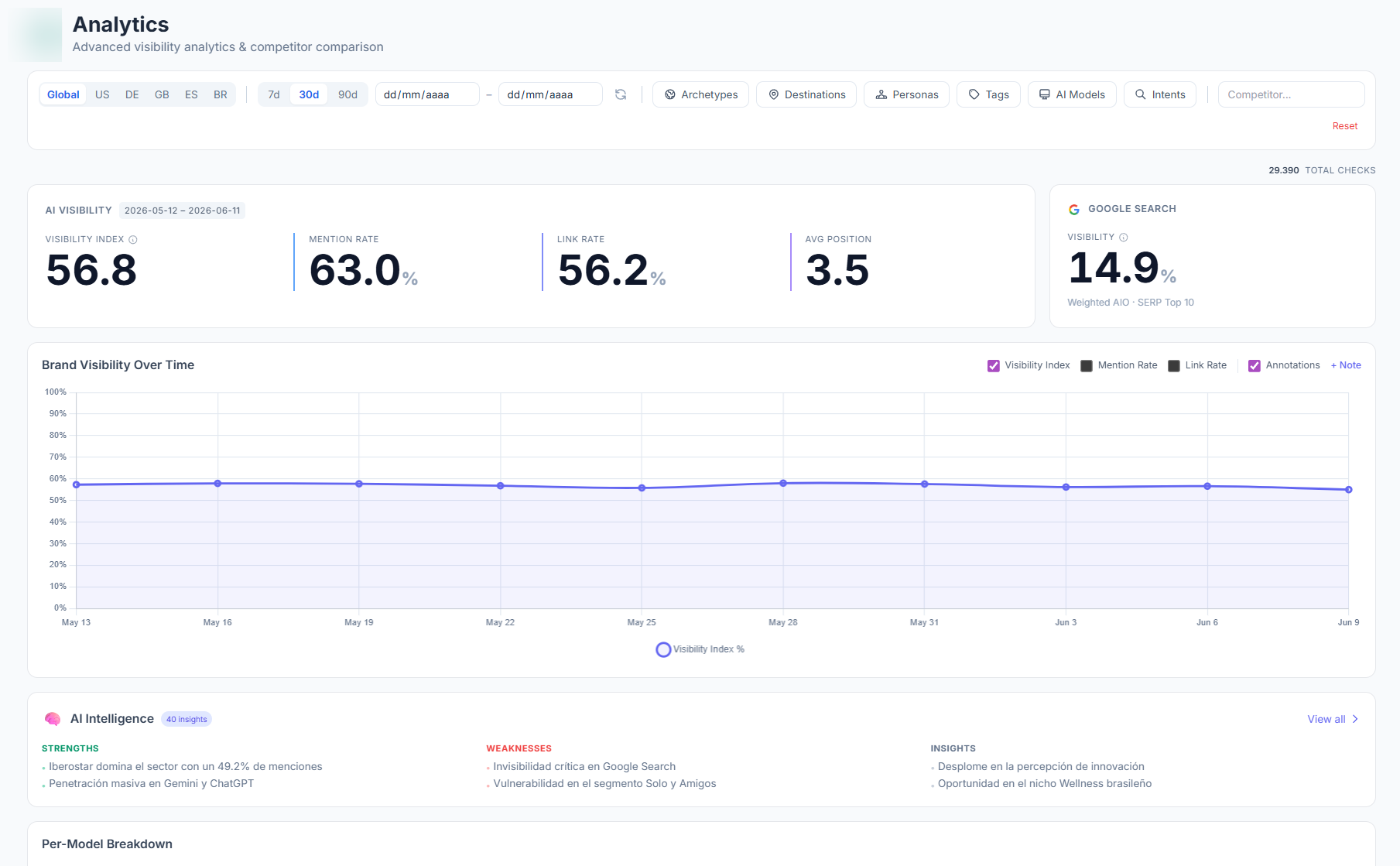
Where AI Analytics sits in the AI SEO Stack
The iceberg of AI traffic
Most AI SEO programs report what's visible above the water line. 70%+ of actionable signal lives below it — in un-attributed traffic, conversions bucketed as "Direct/None," multi-engine journeys never connected to GSC or GA4 without integration.
Above the water
Vanity / visible
- Brand mentions (counted)
- Citations (logged)
- Share of voice (computed)
- Sentiment scores (aggregated)
Below the water
Attribution / hidden
- AI-sourced traffic (in "Direct/None")
- Multi-touch user journeys (deduplicated)
- Conversion events attributed to AI source
- Revenue per engine per prompt
- Cost-per-citation by content type
- ROI per content piece by AI surface
The "lift the water" exercise
When a brand connects AI mentions to verified pipeline for the first time, the typical finding is that AI search was already responsible for 12–22% of un-attributed pipeline — consistent with the 2026 benchmark showing AI referral conversion at 14.2% versus 2.8% for Google organic (Averi 2026 synthesis of Adobe/Semrush/MS Clarity benchmarks). The data was there — the model wasn't.
Native GSC + GA4 integration — close the visibility-to-revenue loop
AI Analytics breaks down when visibility data lives in one tool and traffic/revenue lives in another. Truffle integrates Google Search Console + Google Analytics 4 natively at the project level: connect once, get AI Insights that analyze real data instead of estimates, Keyword Performance with rankings + clicks + CTR per keyword, Traffic Correlation that connects visibility with actual visitors, and Conversion Tracking that surfaces which keywords drive revenue. No 4-vendor stack. No CSV exports. The full loop in one workspace.
Start a 7-day trial →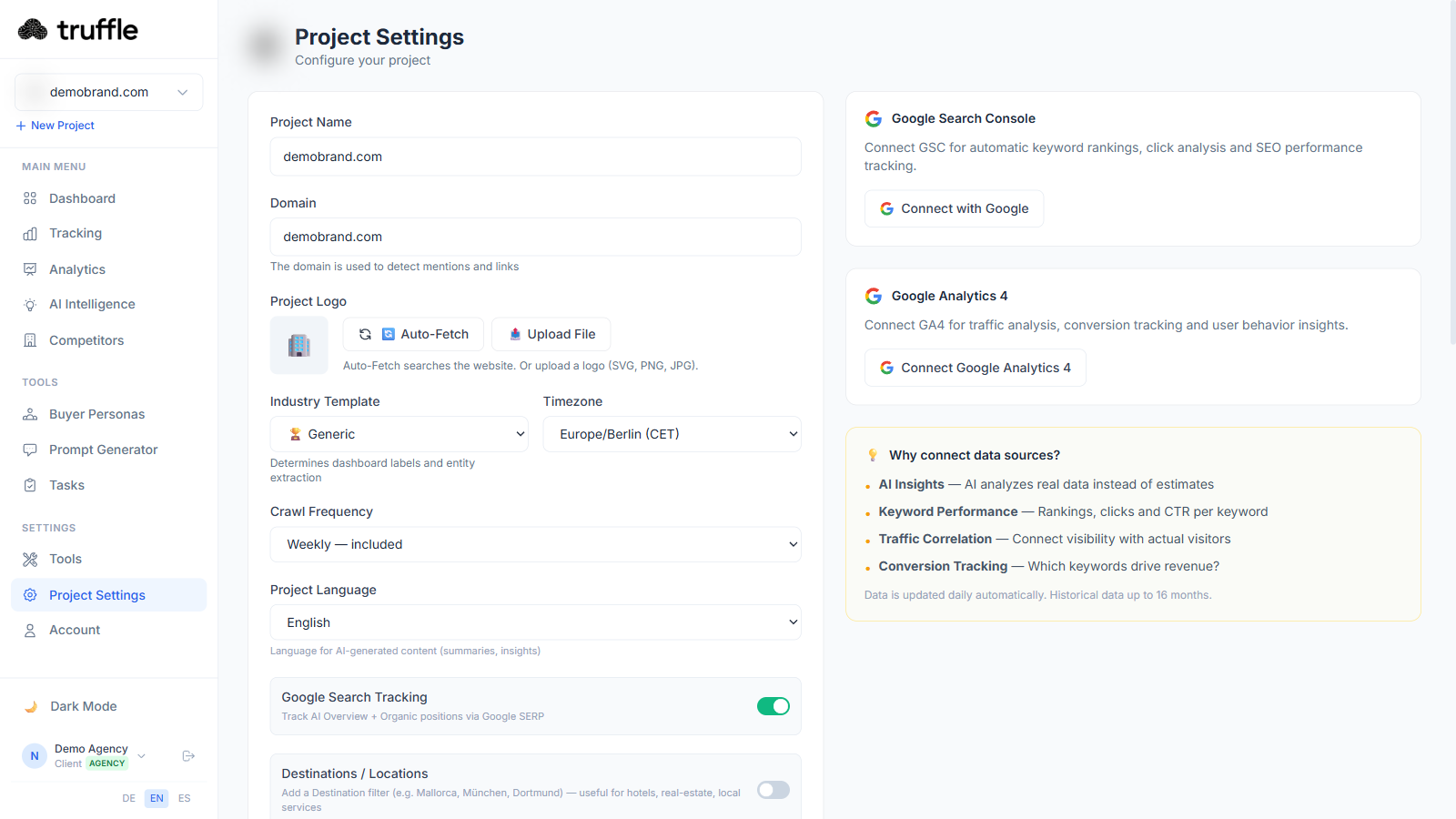
Best AI Analytics tools in 2026 — honest comparison
Six options cover the AI Analytics segment. The deciding axis is whether the platform ships Levels 3–5 native or assumes you'll assemble them from 4 vendors.
| Platform | Levels covered | Engines | CRM | Attribution model | Entry |
|---|---|---|---|---|---|
| Truffle | Levels 1–5 native | 6 every plan | GA4 + GSC native | Multi-touch + dedup | $69 |
| Profound | Levels 1–2 | 1 → 3 | Limited | First-touch | $99 |
| AthenaHQ | Levels 1–3 | 3 | NA | Custom | $295 |
| Google Analytics 4 | Levels 3–4 (no AI source) | NA | Via export | Last-touch default | Free |
| Adobe Analytics | Levels 3–5 (no AI source) | NA | ✓ enterprise | Multi-touch configurable | $50K+/yr |
| BigQuery + Looker | 1–5 (DIY) | NA | Custom | Custom | $30K+ build |
Competitor prices as of 2026-08-23, taken from each vendor's own pricing page. Vendors change plans without notice — check with the vendor before deciding.
The honest concession
Adobe Analytics is the right choice if you're already in Adobe Marketing Cloud. Custom BigQuery + Looker is right if you have a data engineering team and the patience for a 6-month build. Truffle's audience is the team that wants Levels 1–5 attribution shipped in one product — not assembled from 4 vendors.
Brand vs Competitors — see exactly who captures citations and on which intents
Most analytics tools report your visibility in isolation. Truffle's Competitors view ships Brand vs Competitors comparison (Visibility, Mention Rate, Link Rate, Avg Position) side-by-side with your top 4 rivals, a Tag Performance Radar that flags which intent tags each competitor dominates, a Top Brands ranking of the 10 domains capturing citations in your category, and a Brand vs Competitors trend chart over time. Connect GA4 + GSC for the revenue correlation step.
Start a 7-day trial →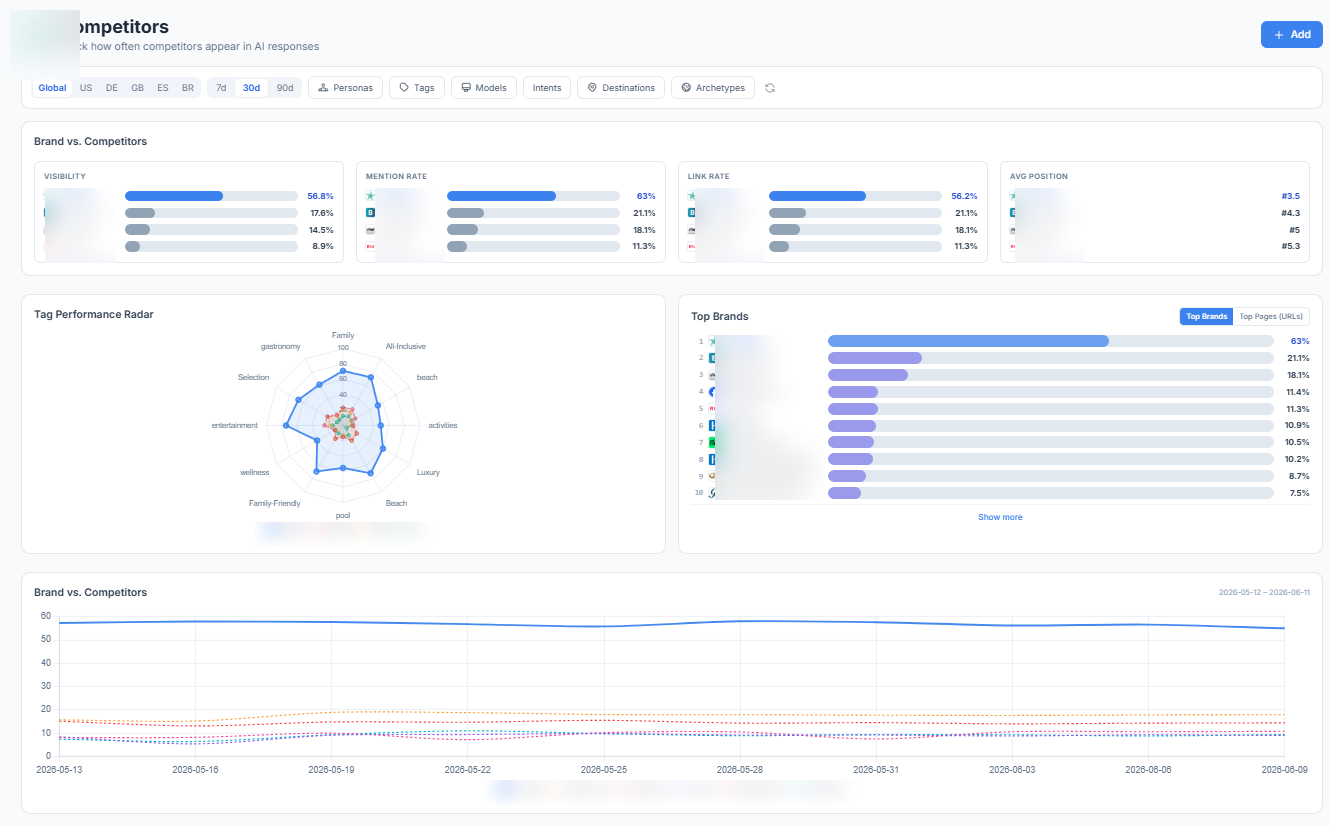
What Level 5 looks like in practice — 3 scenarios
Three realistic ROI projections by brand tier. All assume Truffle's Attribution Engine connected to CRM, running for 90 days.
$5M revenue
8 content pieces · Truffle Pro tier $199/mo
$50M revenue
40 content pieces · Truffle Agency tier $399/mo
$500M+ revenue
200+ content pieces · Truffle Custom plan
Smart Onboarding with attribution baseline in 10 minutes
The first attribution baseline is the hardest because it requires data source connection and AI source disambiguation. Truffle Smart Onboarding runs the full attribution setup as an AI-guided wizard: domain analysis → GA4 + GSC connector → conversion event auto-mapping → first AI Attribution Baseline across 6 engines × 20 prompts. The first ROI estimate arrives the same session.
Start a 7-day trial →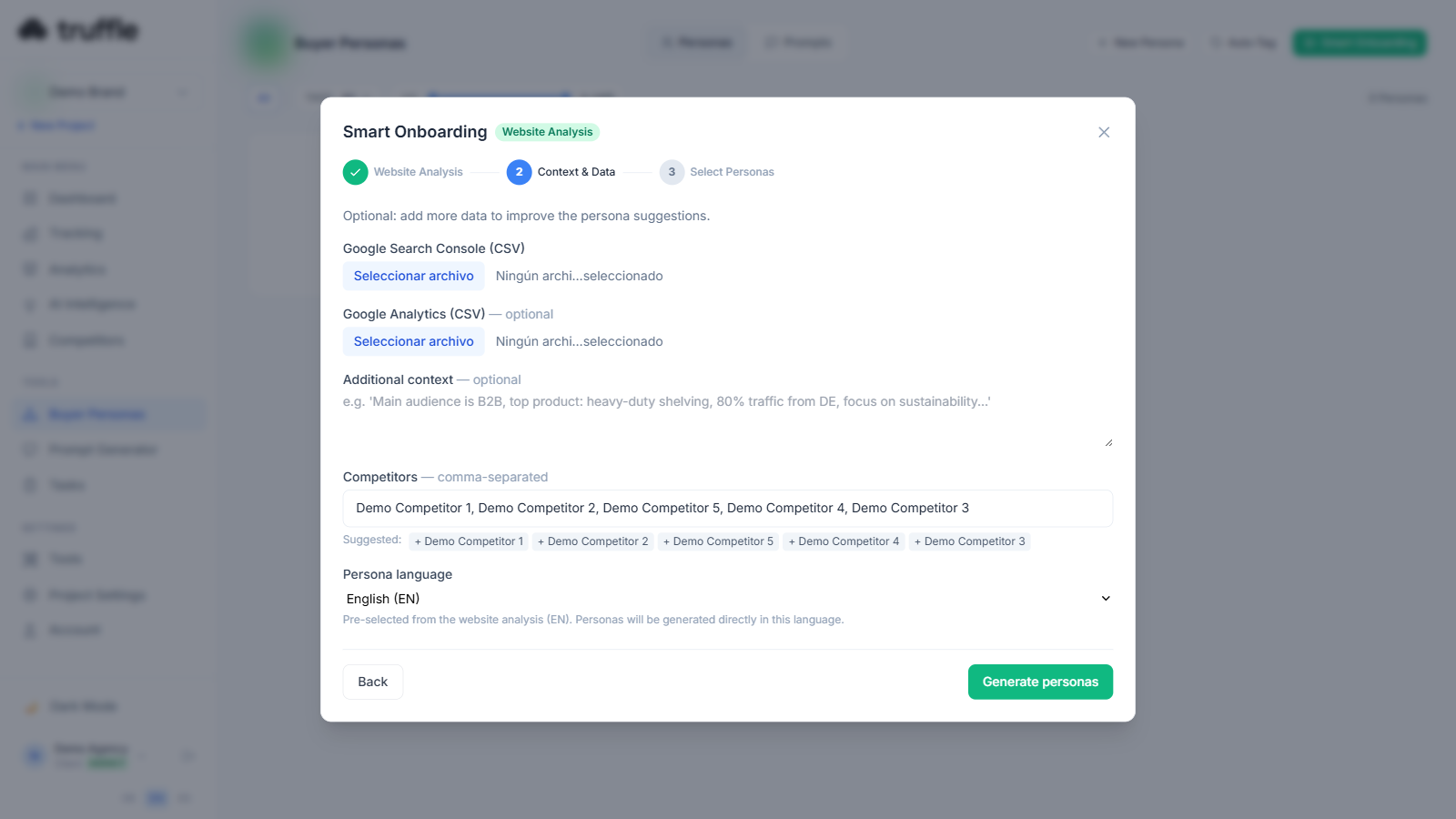
Frequently asked questions
What is AI Analytics?
How is it different from Google Analytics 4?
What is the "attribution gap"?
What's first-touch vs last-touch vs multi-touch attribution?
How does Truffle connect AI visibility to actual revenue?
How long are AI-driven conversion windows?
What are the best AI Analytics tools in 2026?
How quickly can I get to Level 5 attribution?
Stop reporting visibility. Start justifying revenue.
A 7-day Truffle trial connects your CRM, runs the first AI Attribution Baseline across 6 engines, and produces a CFO-ready revenue estimate the same session.
Used by SEO, GEO and revenue-marketing teams across 12+ countries · GDPR-ready · Encrypted backups · Cancel anytime.