AI SEO is the four-layer discipline of being chosen by AI engines
In November 2022, OpenAI launched ChatGPT and changed where buyers ask questions. Three years on, 94% of business buyers report using AI in their buying process (Forrester, Buyers' Journey Survey 2025) — up five points in a single year. AI SEO is the discipline that decides whether your brand is the one cited — or invisible. This is the working framework: what it is, where it came from, how to execute it, and which platforms matter.
7-day trial · no credit card · cancel anytime
If you only have 30 seconds
- AI SEO is the discipline of being cited by LLMs, not just ranked by Google.
- It has four integrated layers: GEO (production) · LLM SEO (technical) · Brand Tracking (observation) · AI Analytics (attribution).
- The category was named in the Aggarwal et al. paper (GEO: Generative Engine Optimization, KDD 2024); in that study, statistics, citations and quoted sources raised visibility in AI answers by up to 40% (arXiv 2311.09735).
The shift is measured, not predicted
The mainstream-adoption inflection is behind us, not ahead. The category has its canonical paper and its named metrics. The discipline is no longer speculative — it's studied.
of business buyers report using AI in their buying process
of marketers have fully integrated AI search and SEO across strategy, execution and reporting — the rest have updated the strategy, not the operating model
of B2B buyers say they prefer a rep-free buying experience
Note on the figures above: all three are taken from the named primary source and linked to it. Other percentages further down this page combine verified industry data with expert projections and trend models — credible directional data, not all of it single-source verified. Detailed methodology and source list available on request.
Share of business buyers using AI in their buying process
Source: Forrester, Buyers’ Journey Survey 2025 — prior-year value from the same series.
What is AI SEO?
AI SEO is the discipline of optimizing brand visibility inside AI search engines — ChatGPT, Claude, Gemini, Perplexity, Google AI Overviews and Google AI Mode — where buyers increasingly start and complete their research before clicking a single SERP.
The term has two meanings still circulating in the industry. The first, older meaning: using AI tools to do traditional SEO faster. The second, current meaning — the one this page uses — is the opposite direction: optimizing for AI search engines as a destination, not using AI as a workflow accelerator. The two practices coexist, but they're distinct disciplines.
Quick definitions used throughout
41 months from ChatGPT to a named, measured discipline
The category that didn't exist in 2022 now has a canonical academic paper, named metrics, and its own tooling ecosystem. The velocity is the story.
Nov 30, 2022
ChatGPT launches
1M users in 5 days · 100M MAU in 2 months — fastest consumer app adoption in history.
Mar–May 2023
Google responds
Bard launches in March · SGE rolls out in May — biggest search architecture shift in a decade.
Nov 2023
The canonical paper
Aggarwal et al. publish "GEO: Generative Engine Optimization" (arXiv 2311.09735, later KDD 2024). The category gets its name and metrics.
2024
Infrastructure forms
Google ships AI Overviews to the US. Jeremy Howard (Answer.AI) proposes llms.txt, a markdown standard for LLMs.
Q2 2026 · now
Window for integrated platforms
Category consolidated, segment fragmented. Marketers know they need to invest. They don't yet know which partner.
The AI SEO Stack: four disciplines, one workflow
AI SEO is not a single tactic. It's four integrated layers that form a closed operational loop. Most platforms cover one or two. The platforms built to last cover all four.
GEO · Production
How content is structured, sourced and proven so LLMs choose to cite it. Semantic depth, named entities, schema, source authority, citation-worthy formats.
Read the GEO playbook →LLM SEO · Technical
Make your content machine-readable. llms.txt files, schema markup, entity resolution, multi-engine crawler optimization, render compatibility.
Read the LLM SEO playbook →Brand Tracking · Observation
Monitor every mention, every engine, every day. Citation rate, share of voice, sentiment, source authority. Catches hallucinations before they reach a customer.
Read the Brand Tracking playbook →AI Analytics · Attribution
Prove AI visibility moves the pipeline. GA4 and GSC integration. AI-sourced traffic correctly labeled instead of falling into Direct.
Read the AI Analytics playbook →How AI SEO differs from traditional SEO
The two disciplines coexist. AI SEO does not replace traditional SEO — it extends it. Google still drives roughly 60% of total search traffic worldwide. What's shifted is where buyer research happens after the initial discovery touch.
| Traditional SEO | AI SEO | |
|---|---|---|
| Output unit | Position 1–10 | Cited / mentioned / position-in-answer |
| Surface tracked | Google, Bing SERPs | ChatGPT, Claude, Gemini, Perplexity, AIO, AI Mode, Grok |
| Ranking signal | Backlinks, on-page, technical health | Citations, brand authority, semantic depth, structured data |
| User intent | Keyword-driven | Conversational, prompt-driven |
| Attribution | GSC click data | Implicit — requires AI Analytics layer |
| Career discipline | 25 years old, mature | 3 years old, accelerating |
The honest insight
AI SEO is closer in mechanics to brand-led PR than to keyword targeting. You don't optimize a page to climb a ranking — you build authority a model trusts enough to cite. The brands that win AI SEO are the brands LLMs already trust, not the ones that gamed a metric.
How to build an AI SEO strategy in 2026
Six steps. The first measurable results appear within 24–48 hours. Compound returns kick in around month three.
Audit your current AI visibility
Before optimizing anything, know what's happening. Where is your brand cited? Which competitors dominate? Which engines mention you, ignore you, describe you incorrectly?
Run a baseline audit before you touch anything else.
Define your priority engines
Not every engine matters equally. Consumer brands prioritize ChatGPT + AIO. Developer-tools care about Perplexity. Regulated industries track Claude. Multi-engine coverage prevents blind spots.
Build coverage for the engines your buyers actually use.
Identify your buyer prompts
The unit of AI SEO is the prompt, not the keyword. Model the conversational questions each buyer persona asks — then track visibility against those prompts daily.
Prompts replace keywords as the operational unit.
Pick your vertical context
Generic optimization underperforms. The same brand fact lands differently in a hotel review than in a SaaS pitch. Truffle ships seven vertical templates — Hotels, Travel, B2B Services, Fashion, E-Commerce, SaaS, Dating.
Your vertical changes what citation-worthy means.
Structure content for citation
This is GEO at the page level. Semantic clarity, named entities, structured data, source authority, citable formats. Work through it factor by factor, or follow your platform's strategy recommendations.
Write for extraction, not for ranking.
Set up tracking and attribution
Daily refresh across every engine. Weekly review of citation movement. Monthly review of pipeline attribution via GA4 + GSC integration. The discipline only becomes defensible at the CFO level when attribution is wired in.
Without attribution, the discipline is indefensible.
What to expect, when
- Days 1–2 — baseline visible across every engine
- Weeks 1–4 — first content adjustments deployed and indexed
- Weeks 4–12 — citation improvements measurable (LLM retraining cycles)
- Months 3–6 — revenue attribution measurable in GA4
- Months 6+ — AI SEO compounds the same way traditional SEO compounds: slow at first, then accelerating
The best AI SEO tools in 2026 — honest comparison
Six platforms lead the segment. Each fits a different buyer profile. The fast scan is below — the full breakdown follows.
| Platform | Engines (entry) | Verticals | Entry price | Free trial | Multi-brand |
|---|---|---|---|---|---|
| Truffle | 6 (incl. SERPs) | 7 + Generic | $69 | 7 days, no card | 15 brands @ $399 |
| Profound | 1 → 3 on Growth | Generic | $99 | None | +$399/mo per client |
| AthenaHQ | 3 | Generic | $295 | None | — |
| Otterly | 1 + add-ons | Generic | $29 | Limited | — |
| Scrunch (now Sitecore) | 2 | Generic | On request | None | — |
| Rankability | Limited | Generic | Agency | None | ✓ |
Competitor prices as of 2026-08-23, taken from each vendor's own pricing page. Vendors change plans without notice — check with the vendor before deciding.
If the table answered your question, jump to Section 8 — How Truffle implements the AI SEO Stack →
Truffle
Best for operators and agencies who want the full AI SEO Stack
$69/mo
7-day trial, no card
The only platform integrating GEO, LLM SEO, Brand Tracking and AI Analytics in one workflow with real revenue attribution. Six AI engines included on every paid plan. Seven vertical templates. Pro/Agency tier at $399/mo covers 15 brands — roughly $27 per client per month.
Profound
Best for Fortune-500 behavioral research
$99/mo
No free trial
One of the established players in the segment. Profound is the right pick if you need its Prompt Volumes panel data, ChatGPT Shopping coverage, white-label multi-client dashboards or Fortune-500 procurement support. Most evaluations begin with a sales call. Claude, Gemini and Grok sit behind custom enterprise pricing ($2,000–5,000+/mo).
AthenaHQ
Best for technical LLM SEO depth
$295/mo
No free trial
The strongest technical depth in the segment. Co-founded by an ex-Google Search and DeepMind engineer, with the ACE Citation Engine as its technical centrepiece. The cost of that depth is a $295 entry tier and an enterprise-flavored sales motion.
Otterly
Best for single-brand monitoring on a small budget
$29/mo
Limited free tier
$29 buys 15 prompts across four engines; Claude, Gemini and AI Mode are paid add-ons on top. That puts it next to free tiers rather than next to paid plans — Truffle's free tier covers 10 prompts with all four top LLMs included. Strong citation research, and the European Search Awards 2026 behind it.
Scrunch
Best for GA4 integration
On request
No free trial
The only legacy competitor with native GA4 integration shipped. Part of Sitecore since June 2026 (acquired). The Brand Experience Platform ("AXP") that Scrunch markets is, per its own roadmap, mostly forward-looking — the working product is the tracker.
Rankability
Best for agencies wanting unlimited clients
Agency tier
No free trial
Co-founded by Nathan Gotch (with Simon L. Smith) for the agency segment specifically. Strong unlimited-client model and well-positioned for mid-market SEO agencies. Engine coverage is narrower than the rest of this list.
The honest concession
Profound is the right choice if you need its panel data or Fortune-500-scale procurement support. AthenaHQ is right if you need ACE-engine-level technical depth. Otterly is right if you need the cheapest single-brand monitoring entry. Truffle's audience is the middle: operators and agencies that want the full AI SEO Stack — six engines, action-first recommendations, multi-vertical depth and real revenue attribution — at agency math.
How Truffle implements the four-layer model
Truffle is built around the AI SEO Stack from day one. Each layer maps to specific product capabilities — here is how.
Layer 1AI Intelligence — Situation Analysis per project
The production layer turns observation into action. Truffle's AI Intelligence view consolidates strengths, weaknesses and insights detected across the six AI engines per project — written in plain editorial language so an SEO lead, a brand manager or a CFO reads the same conclusion.
Each insight maps to a concrete editorial intervention: a page to update, a topic to cover, an engine to prioritize. The team converts insights into tasks in the Tasks board with one click. Production stops being a separate process from observation.
Read the GEO playbook →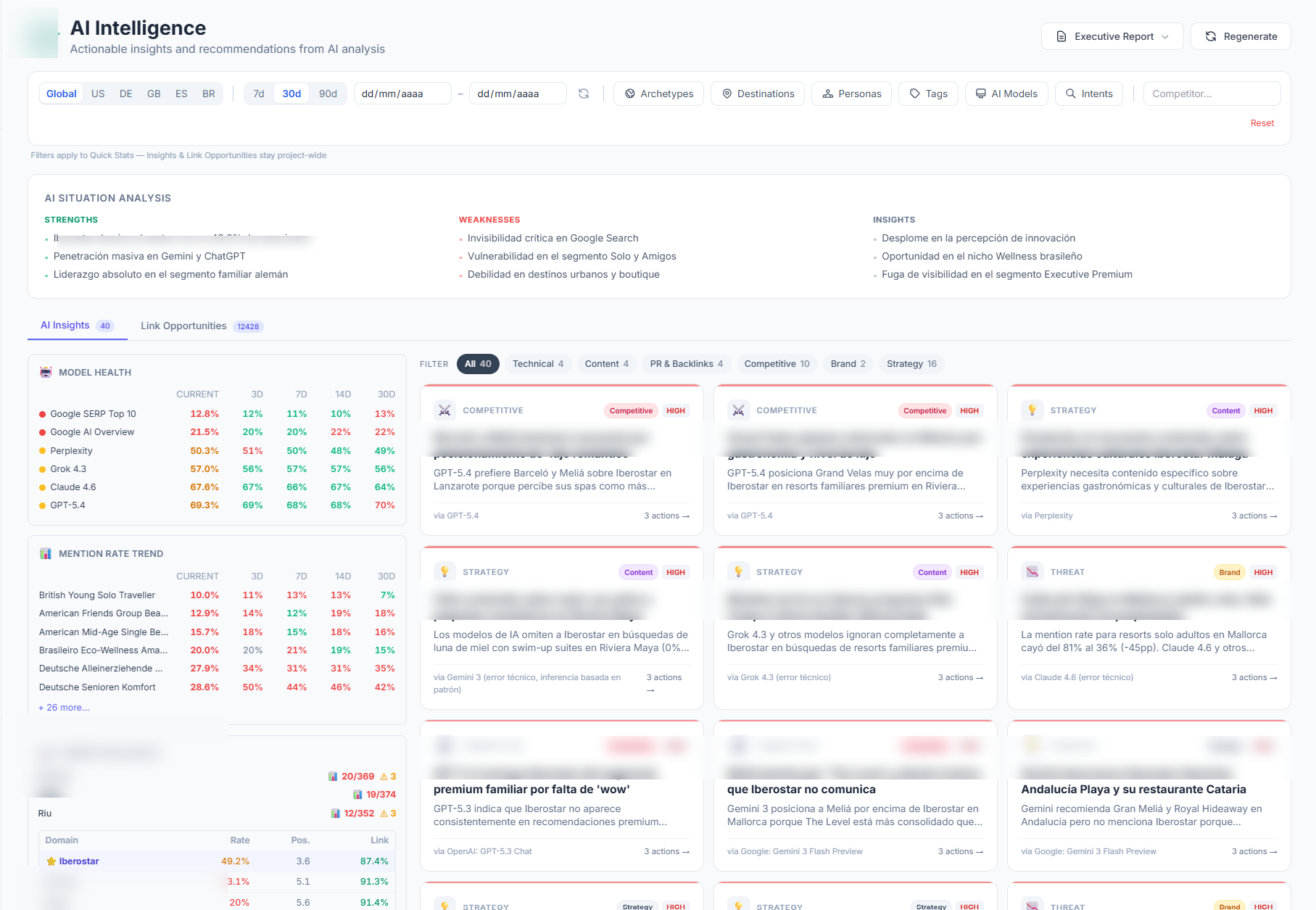
Layer 2Multi-LLM competitor tracking — six engines, every plan, daily refresh
The benchmarking layer tells you who else gets cited and on which intents. Truffle's Competitors view ships Brand vs Competitors comparison (Visibility, Mention Rate, Link Rate, Avg Position) across ChatGPT, Gemini, Perplexity and Grok, a Tag Performance Radar that flags which intent tags each competitor dominates, a Top Brands ranking of the 10 domains capturing citations in your category, and a Brand vs Competitors trend chart that surfaces inflections daily.
No engines gated behind enterprise quotes. No add-ons per engine. The llms.txt generator and schema audit live in the dedicated Tools and Smart Onboarding flows on the LLM SEO playbook.
Read the LLM SEO playbook →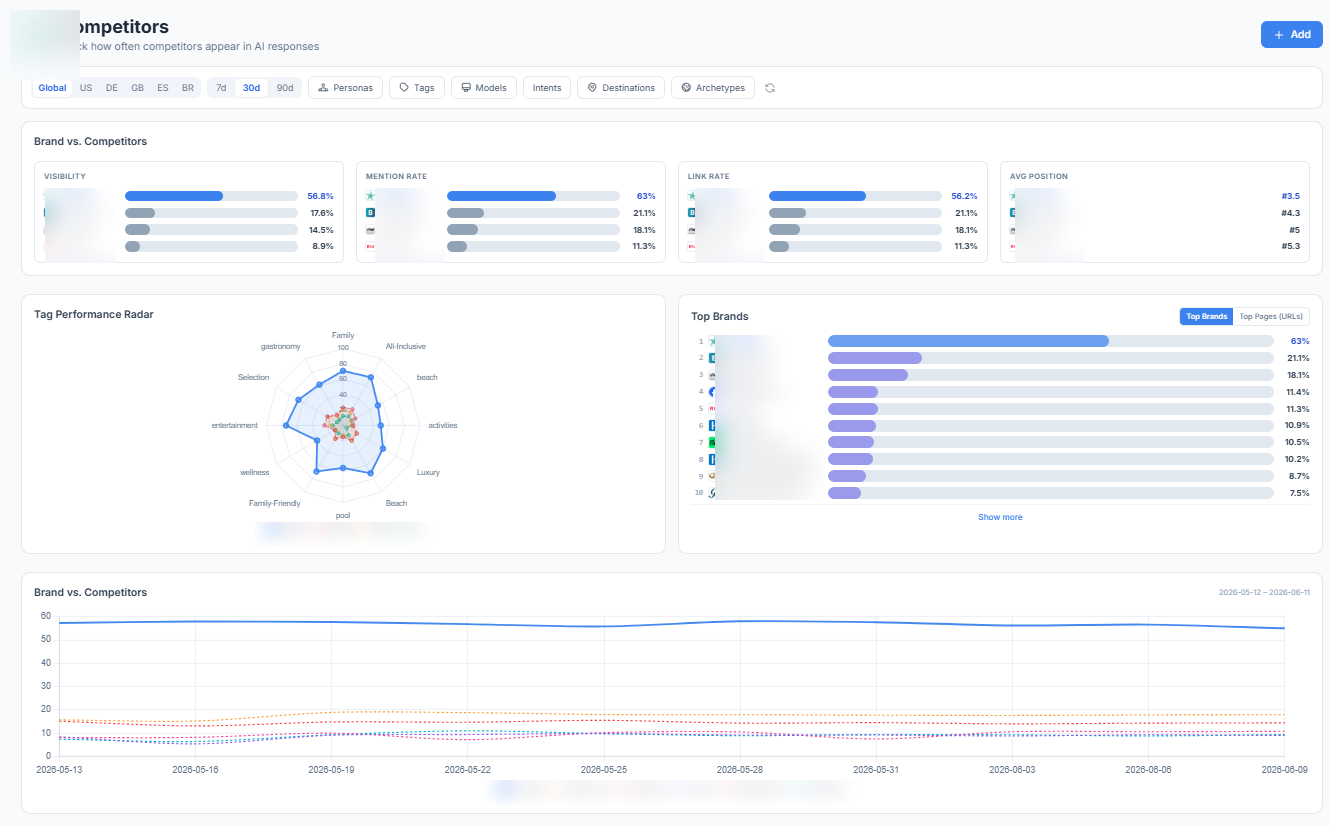
Layer 3Brand Visibility Analytics — Visibility Index, Mention Rate, Brand Visibility Over Time
The observation layer is where most competitors stopped. Truffle's Analytics view consolidates Visibility Index, Mention Rate, Link Rate and Avg Position across the six AI engines into one daily-refreshing dashboard, plus a Brand Visibility Over Time chart that flags inflections immediately.
Each metric breaks down per engine, per persona, per intent — so the conversation moves from "are we visible in AI?" to "which engine drops us on which intent, starting which day."
Read the Brand Tracking playbook →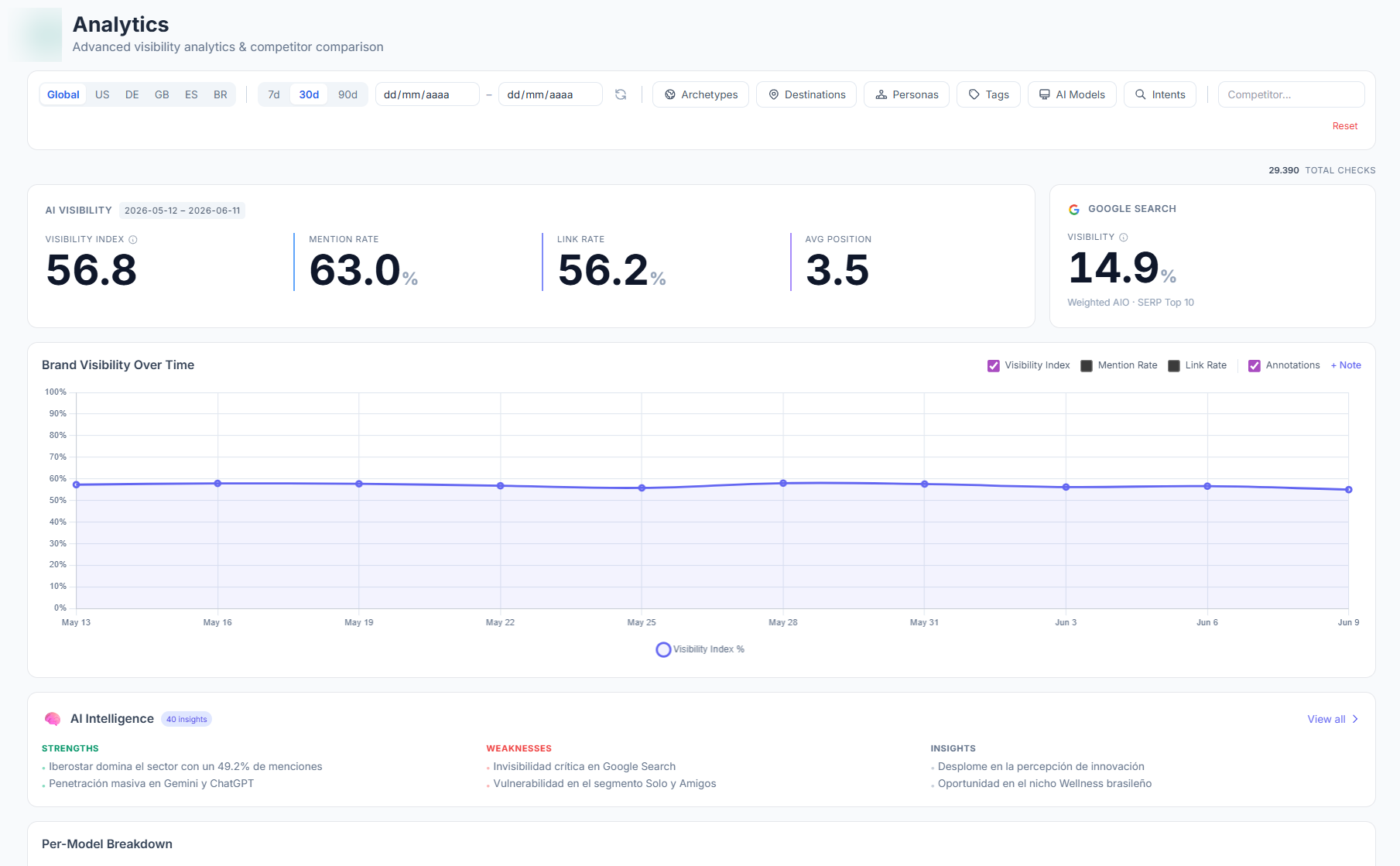
Layer 4GA4 + GSC integration with pipeline attribution
The justification layer is the one no other platform integrates. Truffle connects AI visibility data to GA4 sessions and Google Search Console clicks. AI-sourced traffic gets labeled correctly instead of falling into Direct (where roughly 70% of AI-influenced visits land without a referrer).
The CFO conversation shifts. Instead of "your visibility is up 23% in ChatGPT," the report reads "AI-sourced sessions converted at 14.2% versus your 2.8% Google baseline — here is the pipeline contribution." AI visitors convert at roughly 5× the Google baseline rate (Averi 2026 benchmark synthesis) — but only platforms with native attribution can measure it.
Read the AI Analytics playbook →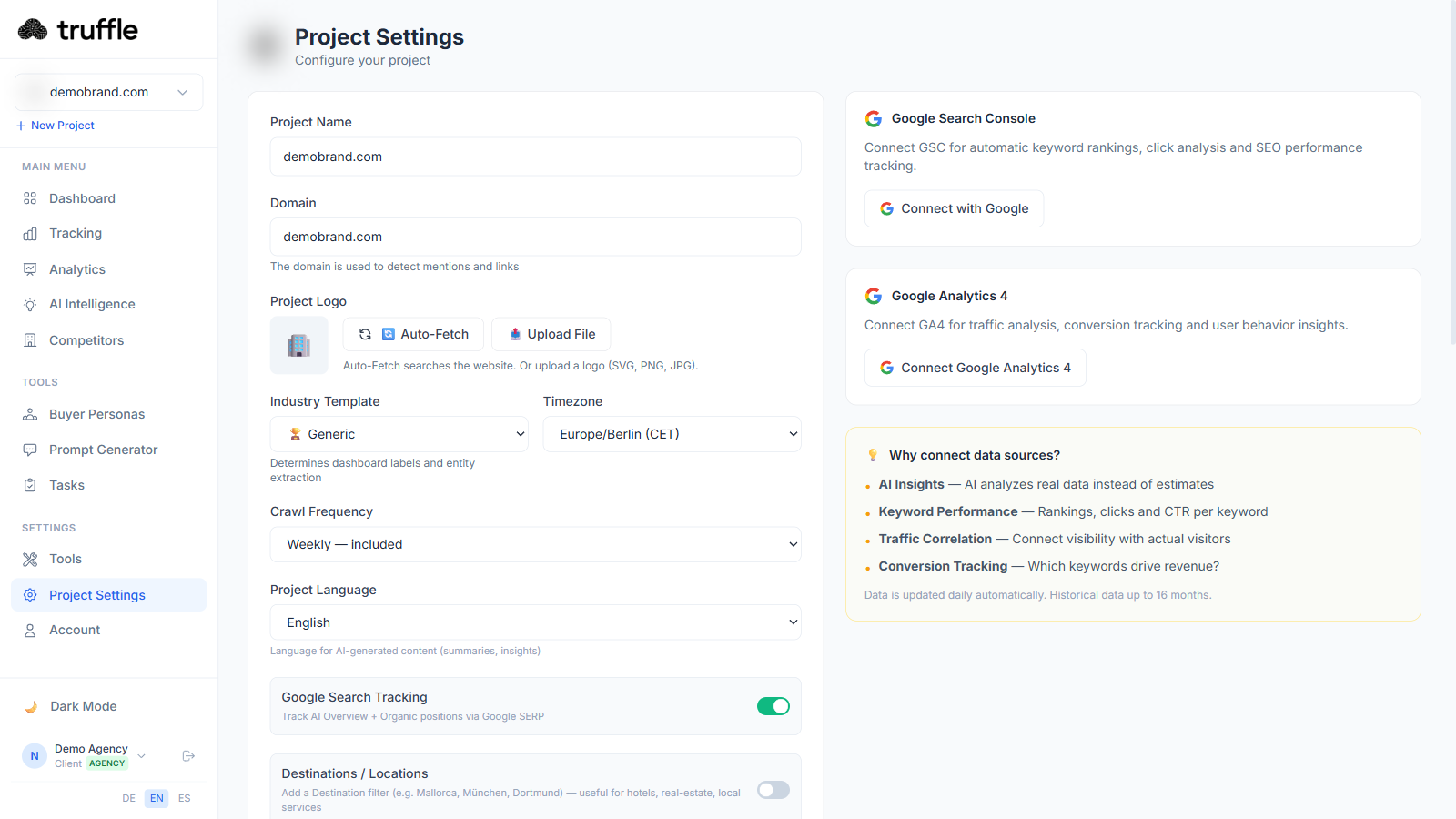
The integrated workflow, in one sentence
Truffle is the only platform where the GEO recommendations you act on, the LLM SEO infrastructure that enables them, the Brand Tracking that measures them, and the AI Analytics that justifies them — all live in the same workspace, refresh on the same daily cadence, and report to the same CFO with one source of truth.
AI SEO for agencies: the math that actually works
Agencies adopting AI SEO as a service line face a specific problem: most platforms in the segment are priced for single-brand teams or for Fortune-500 procurement. The mid-market agency running 10–20 client workspaces ends up paying enterprise prices for monitoring features and still needing a separate tool for action.
The agency math gets favorable when one platform covers all four AI SEO Stack layers, scales across multiple brand workspaces from a single account, and ships under the industry rule that tooling should sit below 5% of an AEO retainer (~$125/month on a $2,500 retainer). At Truffle's Pro/Agency tier — $399/month for 15 brand workspaces — that works out to roughly $27 per client per month. Five-times buffer under the 5% rule.
The agency math
Full AI SEO Stack · six engines · multi-vertical templates · white-label reports · GA4 + GSC

"I run GEO and SEO programs for international clients, so I've evaluated almost every AI visibility tool on the market. For most of my clients, the big enterprise platforms are over-scoped and over-priced — no trial, sales-led onboarding, the models we report on locked behind enterprise tiers. I moved my agency's tracking to Truffle because it covers six surfaces including Google SERPs from the entry tier, ships a real free trial, and tells my team what to fix next instead of just handing us another dashboard. For agencies and mid-market brands, nothing else comes close on time-to-value."
Olesya FranielCEO · Zander Digital Services International · SEO & GEO agency, Barcelona / Dortmund
Frequently asked questions
What is AI SEO?
How is AI SEO different from regular SEO?
Will AI replace SEO?
Will AI kill SEO?
Is AI content bad for SEO?
How does ChatGPT affect SEO?
What is GEO vs AI SEO?
Do I need an AI SEO agency?
What are the best AI SEO tools in 2026?
How long does AI SEO take to show results?
Can I do AI SEO without paying for a platform?
Where do I start with AI SEO?
Start with the framework. Verify it on your own brand.
The AI SEO Stack is the working model. A 7-day Truffle trial is the first step — full feature set, no credit card required.
Trusted by SEO and GEO agencies serving brands across 12+ countries · GDPR-ready · Encrypted backups · Cancel anytime.