AI Brand Tracking is how brands hear themselves in AI answers — across every vertical
AI engines mention your brand whether you're listening or not. ChatGPT recommending healthcare clinics. Claude comparing investment advisors. Perplexity ranking ecommerce stores. Gemini surfacing local services. B2B SaaS gets the headlines — the citation surface spans every vertical that buyers research online. The question this page answers: when AI talks about your category, is your brand part of the conversation?
7-day trial · no credit card · cancel anytime
A regional healthcare network (12 clinics, $40M revenue) launched AI Brand Tracking in Q1 2026 after noticing patients citing ChatGPT as their primary "where should I get care" research source. Baseline: cited in 8% of category queries. After 90 days of GEO content production + technical fixes:
The relevant detail: this wasn't a SaaS brand. Most AI tracking tools cover only B2B technology. Vertical coverage matters.
Source: anonymized client engagement, 2026 · methodology available on request
What is AI Brand Tracking?
AI Brand Tracking is the discipline of monitoring how generative AI engines (ChatGPT, Claude, Perplexity, Gemini, Google AI Overview) mention, rank, sentiment-score and contextualize your brand in synthesized answers — across every vertical your buyers research, not just B2B technology.
It is the observation layer of AI SEO. GEO produces. LLM SEO enables. Brand Tracking observes. AI Analytics justifies.
The discipline emerged from two converging trends in 2024: traditional brand monitoring tools (Brand24, Mention, Hootsuite Insights) realized their social-media-centric model captured zero data from AI conversations, and AI-specific tools (Profound, Peec AI) launched but defaulted to B2B SaaS vocabulary — leaving healthcare, finance, retail, hospitality, legal and local services brands without coverage.
Three operational distinctions matter:
AI Brand Tracking is not social listening. Social listening monitors public posts on Twitter, LinkedIn, Reddit. AI Brand Tracking monitors private conversations between users and AI engines — where the asker won't see your social presence and won't visit your social channels for verification.
AI Brand Tracking is not single-vertical. Most platforms in the segment ship with SaaS-default personas and SaaS-default prompts. A dermatology clinic, a regional law firm, a boutique hotel and a custom ecommerce store all have brand visibility problems in AI engines — but the prompts, personas and competitor sets differ entirely.
AI Brand Tracking is not "just monitoring." The discipline includes sentiment scoring, share-of-voice calculation, competitor benchmarking, citation source identification and response strategy. Pure monitoring without action belongs in the previous generation of tools.
"Most AI brand monitoring platforms are excellent at describing what's happening, but weak at prescribing solutions — users describe them as 'tracking, not optimization'. The brands winning in 2026 will be those who closed that loop early."
Surferstack · 2026 AI Brand Visibility platform review
Glossary · four canonical terms
Built for every brand. Not just the SaaS ones.
Most AI brand tracking platforms ship optimized for B2B SaaS. The default personas are "VP of Marketing." The default competitor sets are SaaS-against-SaaS. The default prompts assume buyer journeys from comparison content. That model fails the moment your brand isn't a SaaS tool.
B2B SaaS
Prompts like "best CRM for mid-market" / "alternatives to Salesforce." Mature segment, multiple competitors, well-served by all platforms.
Healthcare
Prompts like "best dermatologist in [city]" / "is [clinic] reputable." Patients increasingly use ChatGPT as primary care research. Caregiver/patient vocabulary differs from SaaS.
Finance & wealth
Prompts like "best wealth advisor for $5M+" / "is [firm] fiduciary." Trust signals critical. Compliance constraints on content. Highly regulated.
Retail & ecommerce
Prompts like "best running shoes for plantar fasciitis" / "is [store] legit." Product-level granularity. SKU-driven competition. Sentiment outweighs feature comparison.
Hospitality & local
Prompts like "best boutique hotel in Barcelona" / "trusted plumber in [city]." Geographic relevance dominates. Local SEO integration critical.
Legal & professional
Prompts like "best estate attorney in [state]" / "is [firm] reputable for IP litigation." Authority signals, jurisdiction relevance, regulatory compliance.
The vertical math
If your platform only ships B2B SaaS templates, you can serve ~18% of brand tracking demand by industry segment. The other 82% — healthcare, finance, retail, hospitality, legal, local services, B2C consumer goods — needs vertical-specific vocabulary, competitor sets and prompt patterns.
AI-generated Buyer Personas per project — automatic vertical adaptation
Most platforms default to B2B SaaS vocabulary. Truffle's Smart Onboarding analyzes your domain and proposes Buyer Personas automatically — each persona arrives with its own intent tags (informational, transactional), its own tracking prompts, and its own vocabulary matched to your actual industry. A dermatology clinic gets dermatology personas; a regional law firm gets jurisdiction-aware ones; a tech publisher gets startup-founder + VC-investor personas. No generic "VP of Marketing" template.
Start a 7-day trial →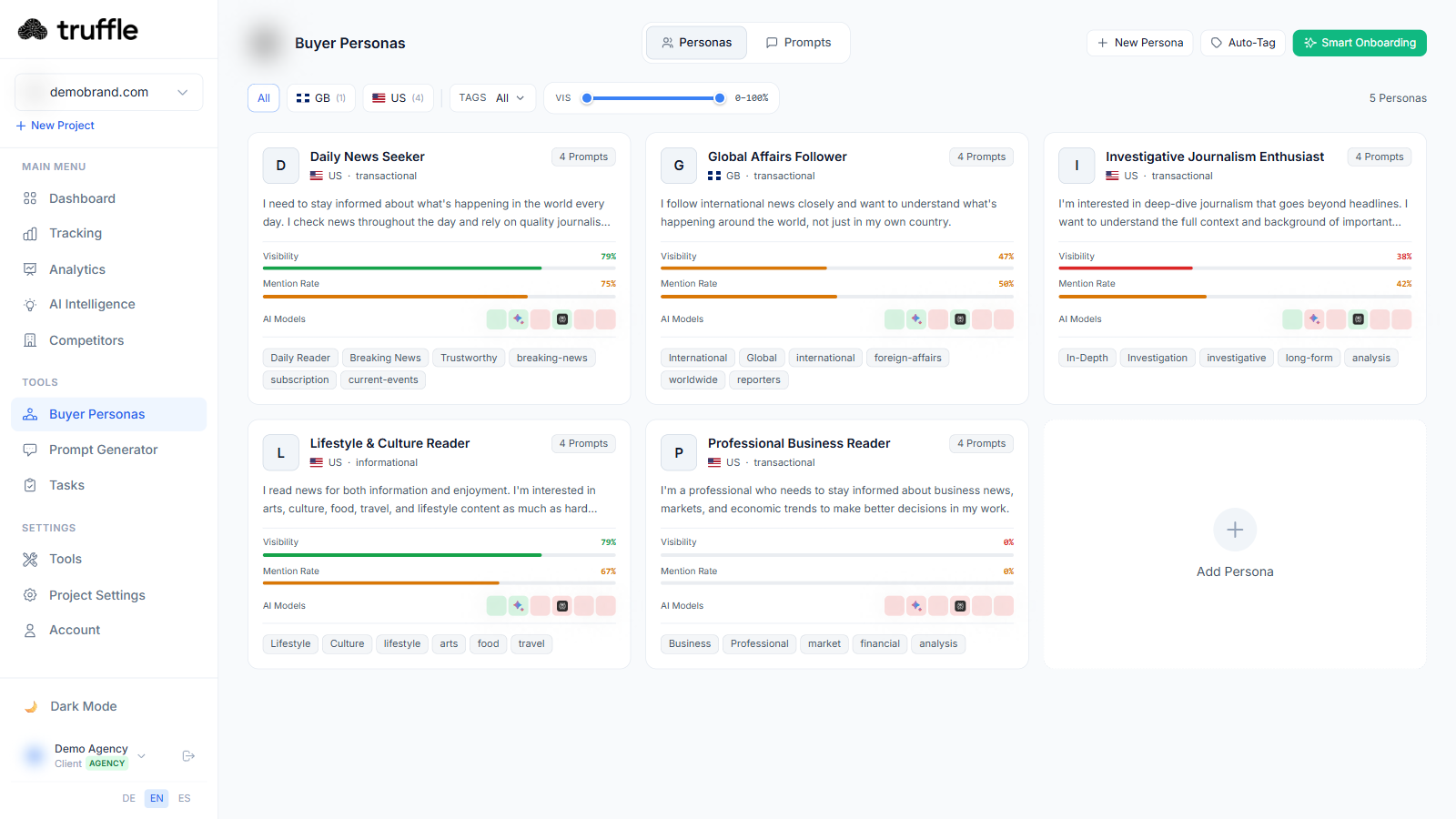
The market behind AI brand tracking
The AI-specific brand tracking segment is the fastest-growing layer of marketing intelligence in 2026 — and the deepest gap between platform coverage and buyer demand. 63% of enterprise marketers plan dedicated AI search budgets for 2026 (press release).
of business buyers report using AI in their buying process — up five points in a year
of marketers have fully integrated AI search and SEO across strategy, execution and reporting
of CMOs call becoming an AI leader a critical goal for 2026
Note on the figures above: market sizing and adoption rates include expert projections and trend models from industry research firms — credible directional data, but not single-source verified to a primary academic study. Detailed methodology and source list available on request.
Net sentiment trajectory · sample brand · Q1 2025 → Q1 2026
Source: anonymized aggregate · sample brand following GEO + Brand Tracking program · methodology available on request
The 3 layers of brand observation
Brand tracking operates at three nested levels of granularity. Most platforms only operate on the outer level. Truffle observes all three.
The action-first principle
A platform that only tracks Circle 1 tells you "you were mentioned 142 times this month." A platform that tracks all three tells you "your San Diego clinic was correctly cited 18 times — 14 citations link to your homepage, 4 to your services page — and competitors gained 11 citations to a blog post about [topic] you don't yet cover." Same data, completely different action.
Competitor benchmarking + Tag Performance Radar — see exactly who gets cited on which intent
Most AI brand tracking platforms count mentions and stop there. Truffle's Competitors view ships four views in one screen: Brand vs Competitors (Visibility, Mention Rate, Link Rate, Avg Position), Tag Performance Radar (which intent tags each competitor dominates), Top Brands ranking (the 10 domains that capture citations in your category), and a Brand vs Competitors trend chart over time. You see not just how often you're cited, but on which queries competitors beat you and why.
Start a 7-day trial →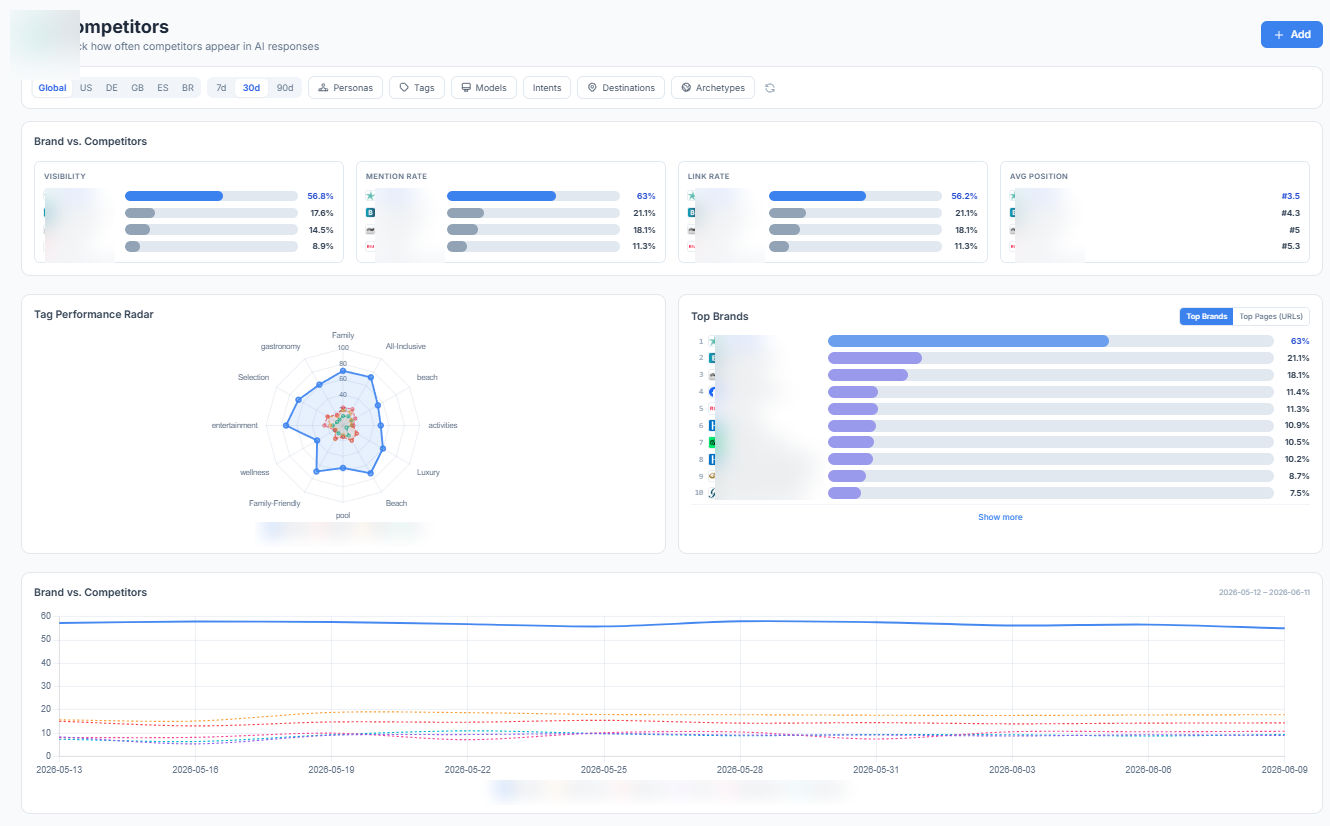
Where Brand Tracking sits in the AI SEO Stack
The 4-step loop that turns tracking into improvement
Brand tracking that stops at "analyze" leaves you informed but not improved. The platforms that close the loop from observation to action outperform pure monitoring tools by 22–28% in citation rate growth — and 32% of digital leaders rank GEO as their top 2026 priority (Similarweb, 2026 Generative AI Brand Visibility Index).
Monitor
Track every mention across 6 AI engines daily. Brand, entity, citation. Sentiment scored per mention.
Analyze
Categorize mentions by sentiment, citation source, query type, vertical context, competitor benchmark. Identify gaps where competitors are cited but you're not.
Respond
Issue editorial responses: GEO content for citation gaps, source outreach to publishers driving competitor citations, content refresh for outdated mentions.
Refresh
LLMs retrain on staggered cycles. The mention that earned positive sentiment in March may slip by September. Continuous tracking re-baselines monthly.
Best AI brand tracking tools in 2026 — honest comparison
Six platforms lead the AI brand tracking segment. Each fits a different buyer profile. Coverage of non-SaaS verticals is the deciding axis.
| Platform | AI engines | Verticals | Action workflow | Entry | Free trial |
|---|---|---|---|---|---|
| Truffle | 6 every plan | 7 verticals | ✓ integrated | $69 | 7 days, no card |
| Profound | 1 → 3 on Growth | SaaS-default | Limited | $99 | None |
| Peec AI | 4 | SaaS-default | Tracking-only | €85 | 14-day |
| Brand24 | 0 AI (social only) | All verticals | Social-only | $79 | 14-day |
| Mention | 0 AI (social only) | All verticals | Social-only | $49 | 14-day |
| AthenaHQ | 3 (ACE engine) | SaaS-default | Limited | $295 | None |
Competitor prices as of 2026-08-23, taken from each vendor's own pricing page. Vendors change plans without notice — check with the vendor before deciding.
The honest concession
Profound is the right choice for Fortune-500 SaaS procurement clearance. Peec AI is right for SaaS-only tracking with strong reporting. Brand24 and Mention remain right for traditional social listening (still useful — just a different layer). Truffle's audience is the brand outside B2B SaaS that needs full AI brand tracking with vertical templates and action workflow built in.
Cross-vertical workspaces — same agency, multiple categories
Multi-brand workspaces matter for agencies and holdings. Truffle's Pro/Agency tier ($399/month) covers 15 brand workspaces — a dermatology clinic in one workspace, a boutique hotel in another, a legal firm in a third. Each runs vertical-specific templates. Each tracks vertical-specific competitors. Each reports to vertical-specific clients. Agency math: ~$27/client/month.
Start a 7-day trial →
Smart Onboarding — first vertical baseline in 10 minutes
Most brand tracking platforms require 2–3 weeks to scope: define brand entities, build competitor lists, configure persona prompts, integrate alert routing. Truffle Smart Onboarding runs the full setup as an AI-guided 3-step wizard with automatic vertical detection: domain analysis (30 seconds), vertical-specific persona generation (2 minutes), first brand visibility baseline across 6 engines × 20 prompts (5–7 minutes). The first competitor benchmark arrives the same session.
Start a 7-day trial →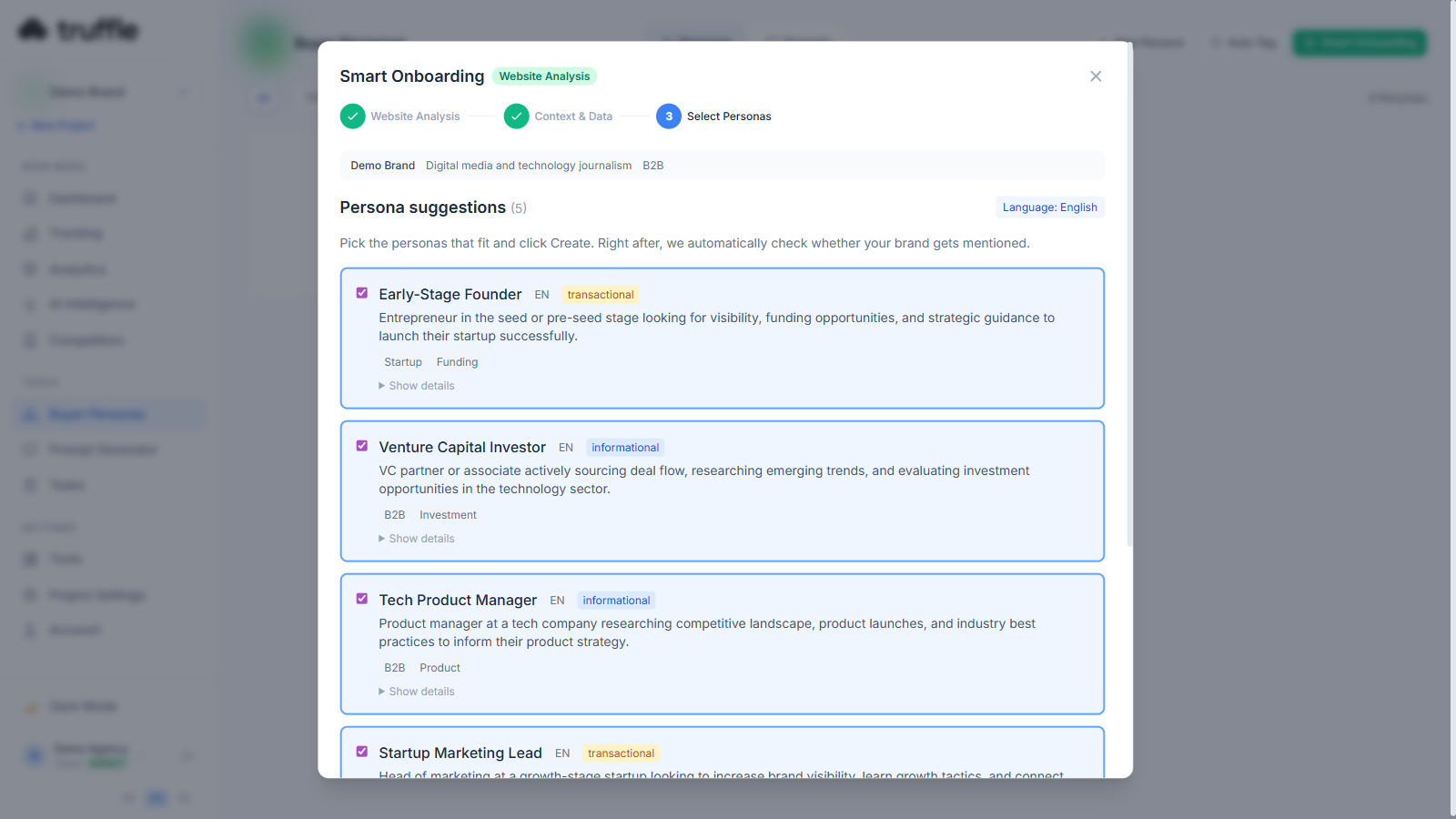
Frequently asked questions
What is AI Brand Tracking?
How is it different from social listening?
Does it work for non-SaaS brands?
What does "share of voice" mean in AI Brand Tracking?
How is net sentiment calculated?
What are the best AI brand tracking tools in 2026?
Should I use a brand tracking agency?
How long does AI Brand Tracking take to deliver insight?
Hear your brand in the conversation. Across every vertical you serve.
A 7-day Truffle trial shows you where your brand stands today in ChatGPT, Claude, Perplexity, Gemini and Google AI Overview — with vertical templates for your specific category.
Used by brands across 12+ verticals · GDPR-ready · Encrypted backups · Cancel anytime.