
Generative Engine Optimization is how brands earn citations in AI answers
GEO is the editorial discipline of structuring content so ChatGPT, Claude, Perplexity, Gemini and Google AI Overviews choose to cite you when buyers ask about your category. It was named at Princeton in 2023, formalized by Aggarwal et al., and now sized by market researchers at $1.78B for 2026.
7-day trial · no credit card · cancel anytime
$1.78B in 2026
GEO services market, heading to $22B by 2034 — a market-research projection, not an audited figure (IntelMarket Research, 2026).
up to +40% citation visibility
When content includes statistics, quotations and cited sources (GEO paper, KDD 2024).
81% vs 36%
Teams running SEO and AI search as one workflow report more traffic or leads from AI platforms — against teams running them separately (Semrush, 2026).
What is Generative Engine Optimization?
Generative Engine Optimization (GEO) is the practice of structuring and producing digital content — text, data, citations, structured markup — to maximize the probability of being discovered, retrieved and cited as a source by generative AI engines (ChatGPT, Claude, Perplexity, Gemini, Google AI Overviews) in the answers they synthesize for user queries.
The discipline was formally introduced in November 2023 in the canonical academic paper "GEO: Generative Engine Optimization" by Aggarwal, Murahari, Rajpurohit, Kalyan, Narasimhan and Deshpande (Princeton, Georgia Tech, Allen Institute for AI, IIT Delhi), accepted to KDD 2024. That paper did three things at once: it named the discipline, defined two visibility metrics (Position-Adjusted Word Count and Subjective Impression), and ran the first controlled experiment — 9 GEO methods evaluated against a benchmark of 10,000 queries — whose findings underpin practically all commercial GEO literature since.
"We introduce Generative Engine Optimization (GEO), the first novel paradigm to aid content creators in improving their content visibility in generative engine responses."
Aggarwal et al. · GEO: Generative Engine Optimization · KDD 2024
Three distinctions matter operationally:
GEO is not "SEO with schema sprinkled on top." Michael King (founder of iPullRank, author of The AI Search Manual) argues the shift runs deeper than markup: "the SEO frame is so limiting," he says, proposing a reinvention he calls "relevance engineering" (Search Engine Land, SMX Advanced 2025).
GEO is not AEO (Answer Engine Optimization). GEO optimizes for multi-source synthesis (the AI blends several sources, weighted by relevance). AEO optimizes for single-answer extraction (the AI picks one source and quotes it). Different strategies, different success metrics.
GEO is not exclusive to one platform. Optimizing only for ChatGPT leaves out every query running through Perplexity, Claude, Gemini and Google AI Mode. Each engine draws on its own source set, so coverage has to be earned per engine — a citation in one does not carry over to the next.
GEO · how the paper measures visibility
The market behind the discipline
The research firm IntelMarket puts the GEO services market at $1.78B in 2026, heading toward $22B by 2034. Treat it as what it is: a vendor projection for a market too young to have audited numbers.
GEO services market in 2026, projected at $22B by 2034
visibility lift in AI answers when content carries statistics, quotations and cited sources
of teams with SEO and AI search in one workflow report more traffic or leads from AI platforms — against teams running them separately
GEO services market — vendor projection
Source: IntelMarket Research, 2026 — the two values the report itself states. Market-research projection, not an audited figure.
Note on the figures above: market sizing and adoption rates include expert projections and trend models from industry research firms — credible directional data, but not single-source verified to a primary academic study. Detailed methodology and source list available on request.
Where GEO sits in the AI SEO Stack
GEO is the editorial production layer of AI SEO. It works on the question what should I publish so that LLMs choose to cite me? The other three layers operate alongside it. They form a closed loop: production → enablement → observation → justification.
The four layers of AI SEO
You are reading the GEO playbook. Read the full AI SEO Stack on the AI SEO pillar to understand how the four layers integrate.
GEO vs SEO: how the two disciplines differ
The two disciplines coexist. GEO does not replace SEO — it complements it. Traditional SEO optimizes for ranking on a results page. GEO optimizes for citation inside a synthesized answer. The mechanics differ at every level.
| Traditional SEO | GEO | |
|---|---|---|
| Output unit | Position 1–10 | Cited / synthesized / attributed |
| Surface tracked | Google + Bing SERPs | ChatGPT, Claude, Perplexity, Gemini, AI Overviews, AI Mode |
| Ranking signal | Backlinks · on-page · technical health | Semantic depth · structured data · source authority · stat density |
| Content strategy | Keyword-driven, length-driven | Citation-worthy, extraction-ready, datable |
| Success metric | Click-through rate, ranking position | Impression score · citation recall · citation precision (Aggarwal) |
The mental shift
SEO asks "how do I rank?". GEO asks "how do I become the source the model selects?". The first is a positioning problem. The second is an authority problem — closer to brand-led PR than to keyword targeting.

"So we have nothing that does anything like that."
Michael King · Founder, iPullRank · Author of The AI Search Manual — on the gap between today's SEO tooling and how AI engines fan out a query and synthesize the answer (Search Engine Land, SMX Advanced 2025)
How to do GEO: the 6-factor framework
Six factors, the way we group the work at Truffle. It is not a standard and nobody certifies it — it is the grouping that survived contact with client work. Onely's GEO audit checklist covers similar ground in 10 steps if you want a second reading.
Semantic clarity
Models cite content they can parse cleanly. Short paragraphs. Clear topic sentences. Named entities resolved to canonical forms. The page should read well to a human and parse cleanly to a tokenizer.
Write for extraction, not just for reading.
Statistical density
In the GEO study, statistics, quotations and cited sources lifted visibility in AI answers by up to 40%. Generic claims get filtered. Specific claims with attribution get cited.
Datable facts compound. Vague claims don't.
Source authority signals
LLMs weigh source reputation. Outbound links to authoritative references (academic papers, regulatory bodies, top-tier publications) signal trust. Pages that cite well read as research.
Cite your sources. Models read the citations.
Structured markup
Schema.org markup — Article, FAQPage, HowTo. FAQ schema is the highest-density GEO format available (Averi 2026 Schema for AI Citations Guide) because it pre-structures content into the exact question-answer shape models use to retrieve information.
Schema is the API your content exposes to LLMs.
Multi-engine coverage
Optimizing for ChatGPT alone leaves out every query flowing through Perplexity, Claude, Gemini and Google AI Mode. Those engines draw on different source sets, so a citation earned in one does not carry over.
Single-engine GEO is structurally weaker.
Continuous refresh
LLMs retrain on staggered cycles. A page that earned citations in March may slip by September if the data isn't refreshed. GEO is not a one-shot project — it's an ongoing editorial discipline.
GEO compounds when refreshed. It decays when frozen.
How the factors reinforce each other
The six factors aren't independent. Statistical density is more cite-worthy when paired with source authority. Schema markup is more effective when paired with semantic clarity. The platforms that close the loop from observation to action (Factors 5 and 6 measured automatically; Factors 1–4 surfaced as recommendations) outperform tools that only measure.
AI Intelligence — strengths, weaknesses and insights mapped to GEO factors
Most GEO tools tell you that ChatGPT isn't citing you. They stop there. Truffle's AI Intelligence view consolidates strengths, weaknesses and insights detected across the six AI engines per project — each item written in plain editorial language so the SEO lead, the brand manager and the CFO read the same conclusion. Weaknesses map directly to the GEO factors above: statistical density, citation authority, structured markup, multi-engine coverage. Insights convert into tasks on the Tasks board with one click.
Start a 7-day trial →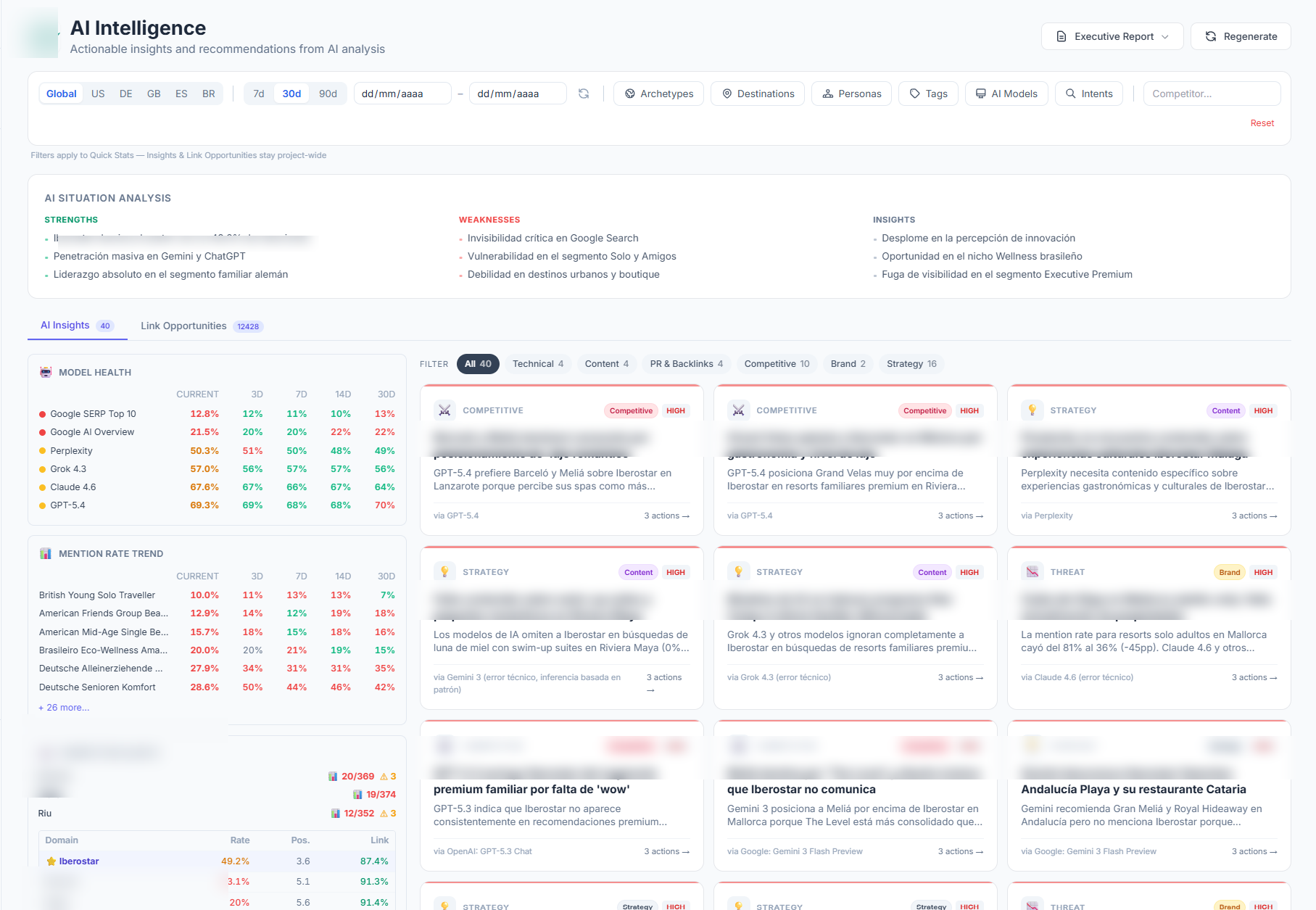
The best GEO tools in 2026 — honest comparison
Six platforms lead the GEO segment in 2026. Each fits a different buyer profile. The fast scan is below — the full breakdown follows.
| Platform | GEO scope | Engines (entry) | Strategy + tasks | Entry price | Free trial |
|---|---|---|---|---|---|
| Truffle | Full (production + measurement + action) | 6 | ✓ every plan | $69 | 7 days, no card |
| Profound | Measurement + research | 1 → 3 on Growth | Reporting-first | $99 | None |
| AthenaHQ | Technical depth | 3 | Limited | $295 | None |
| Surfer SEO | Editorial overlays | Limited | Editorial only | €158 | Limited |
| Writesonic | Generation + publishing | Limited | Generation-focused | $199 | Limited |
| BrightEdge | Enterprise entity | Custom | Reporting | Custom | None |
Competitor prices as of 2026-08-23, taken from each vendor's own pricing page. Vendors change plans without notice — check with the vendor before deciding.
If the table answered your question, jump to Section 7 — How Truffle ships GEO →
Truffle
Best for operators and agencies who want GEO with action built in
$69/mo
7-day trial, no card
The only GEO platform that ships Strategy Recommendations + Source Outreach + AI Generate as integrated workflow — observation that converts to assignable tasks in one click. Six AI engines included on every paid plan. Seven vertical content templates. Multi-brand workspaces from $69. The Pro/Agency tier at $399/month covers 15 brand workspaces — agency math at roughly $27 per client per month.
Profound
Best for Fortune-500 behavioral research at enterprise scale
$99/mo
No free trial
One of the established players in the segment. Right pick if you need Prompt Volumes panel data, ChatGPT Shopping coverage, white-label dashboards or Fortune-500 procurement support. Most evaluations begin with a sales call. Claude, Gemini and Grok sit in custom enterprise quotes ($2,000–5,000+/mo).
AthenaHQ
Best for technical GEO depth via the ACE engine
$295/mo
No free trial
The strongest technical depth in the GEO segment. Co-founded by an ex-Google Search and DeepMind engineer, with the ACE Citation Engine as its technical centrepiece. Cost of that depth is a $295 entry tier and enterprise sales motion.
Surfer SEO
Best for content optimization with GEO overlays
~$249/mo
Limited trial
Long-established content optimization tool that added GEO-style overlays in 2025. Strong on-page editorial guidance, weaker on multi-engine tracking. Right pick if your team is already deep in Surfer; weaker as a standalone GEO platform.
Writesonic
Best for content generation + GEO publishing pipeline
$199/mo
Limited
Combines GEO content drafting with publishing workflows. Strong if your bottleneck is volume of content production; weaker if your bottleneck is editorial precision or multi-engine measurement.
BrightEdge
Best for enterprise entity optimization
Custom
None
Legacy enterprise SEO platform that added GEO-adjacent entity optimization in 2025. Strong knowledge-graph alignment, expensive entry, opaque pricing. Right pick for Fortune-500 brands already running BrightEdge for traditional SEO.
The honest concession
Profound is the right choice if you need its Prompt Volumes panel data or Fortune-500 procurement clearance. AthenaHQ is right if you need ACE-engine-level technical depth. Surfer SEO is right if your team already lives there for content optimization. Truffle's audience is the agency or operator that wants full GEO — production, multi-engine measurement and action — without enterprise pricing or a sales call.
The rest of the Truffle GEO workflow
You saw Capability 1 (Strategy Recommendations) above. Two more capabilities round out the daily editorial loop — outreach and content generation.
Capability 2Link Opportunities — the publishers that LLMs cite in your category
LLMs pull citations from a relatively narrow set of sources per category. Truffle's Link Opportunities view surfaces them automatically — ranked by score, segmented into Blogs, PR & Media, OTAs and Hotels, and flagged for citation status. The team filters by High Potential, exports the list, and routes outreach to the sources that actually move citations.
Start a 7-day trial →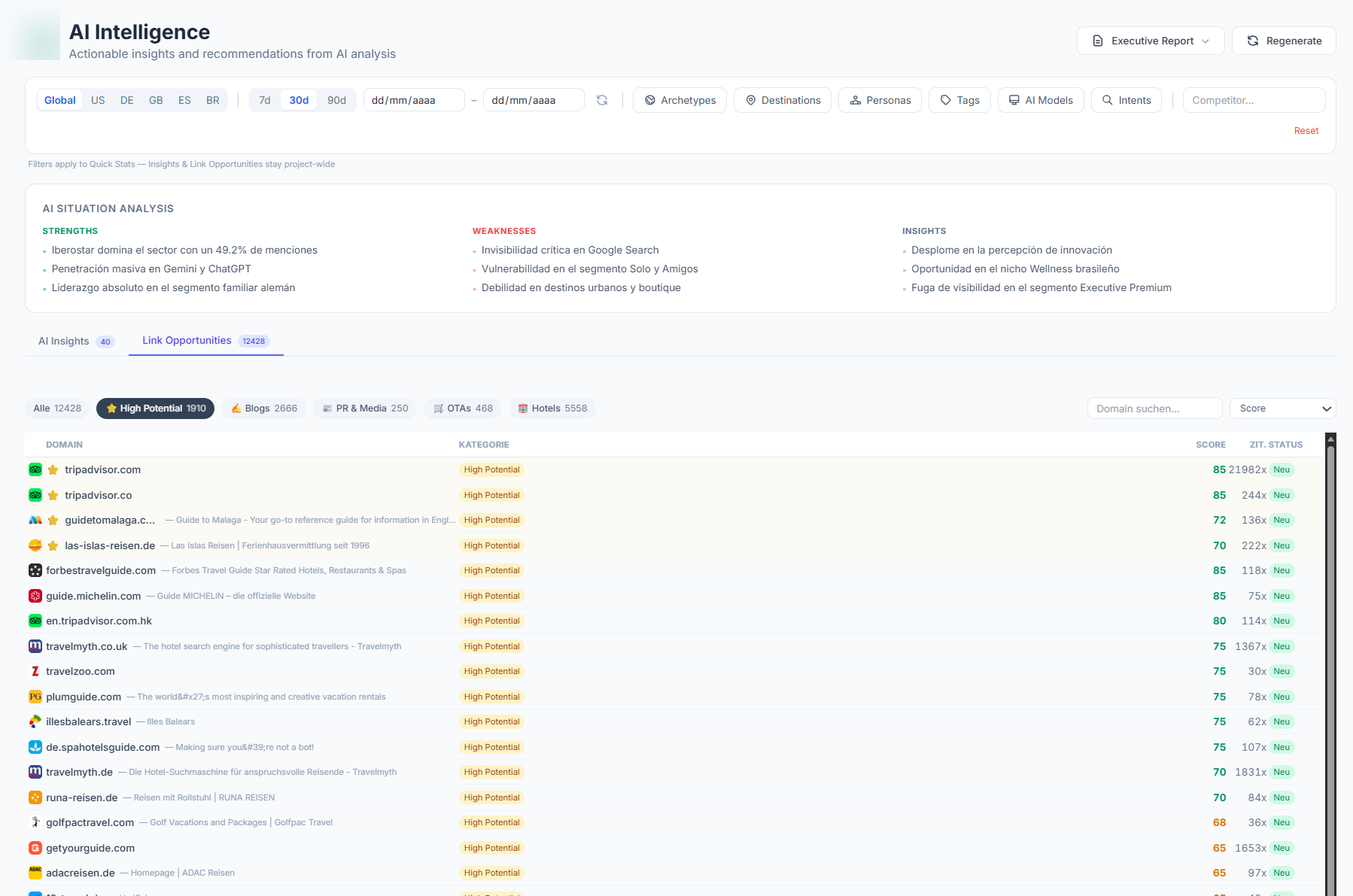
Capability 3AI Generate: 10 LLM models for prompt and content production
GEO production runs on understanding what prompts your buyers ask and which content shapes earn citations. Truffle's AI Generate integrates the same engines the tracker measures — OpenAI, Anthropic, Google Gemini, Perplexity, xAI plus Google AI Overview and SERP top-10 simulators — so you can model prompts, draft content variations and test citation-worthiness across engines from one workflow. No add-on per engine.
Start a 7-day trial →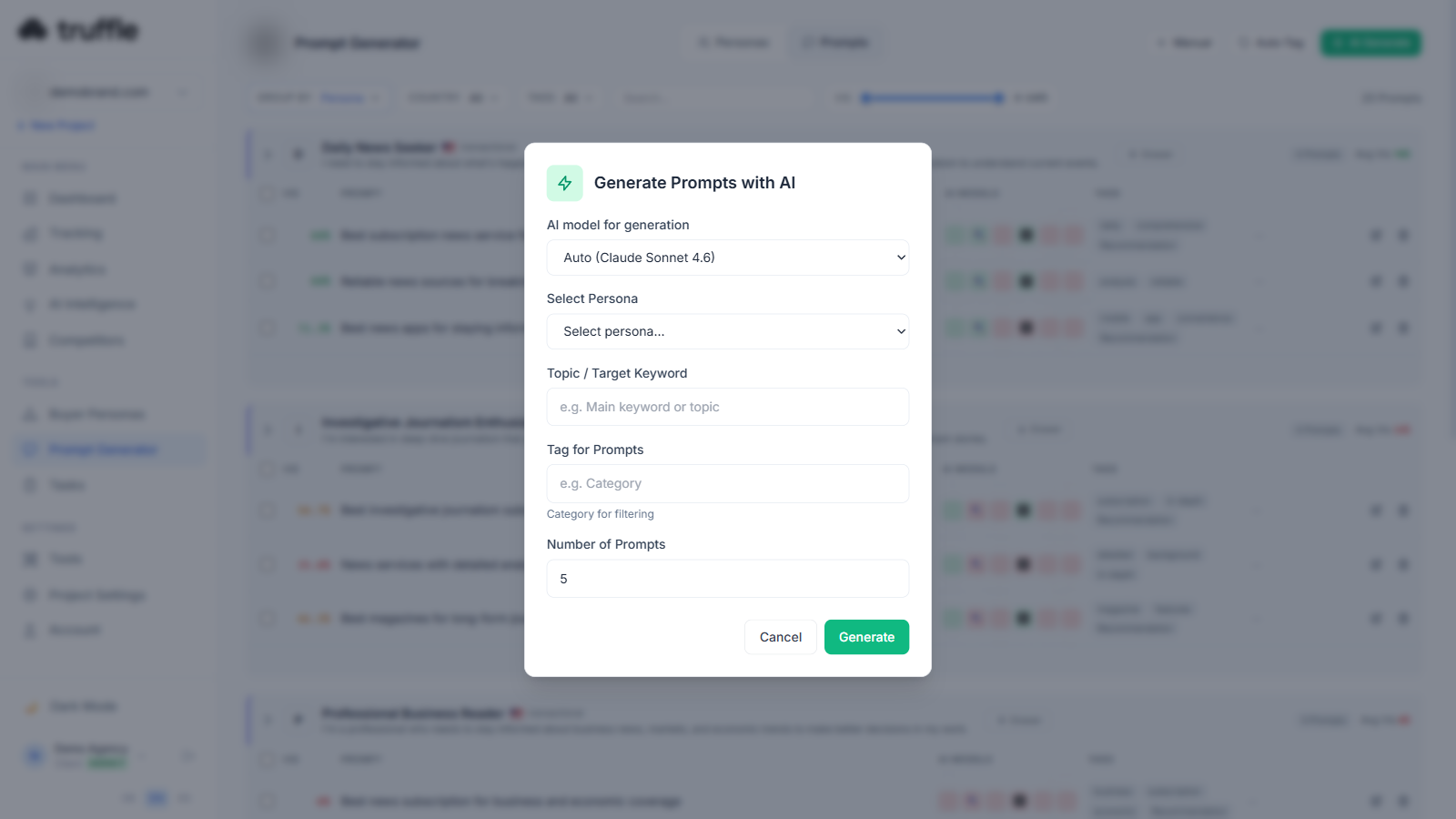
The action-first principle
Most platforms in the segment treat GEO as a tracking problem. Truffle treats GEO as an operational discipline — observe, recommend, act, attribute, refresh. Capabilities 1–3 above are the daily editorial backbone. Capability 4 (Smart Onboarding) sits in the next section, where it belongs — at the start of an agency engagement.
GEO for agencies: when to hire one (and what to expect)
A mid-market B2B SaaS brand contracted a GEO agency in Q4 2025. After 90 days: 3× citation rate in ChatGPT, +38% share of voice across 6 engines, and four citations earned in Perplexity for queries previously dominated by Profound's own content. Retainer: $5,400/month. Tooling: under 5% of fee.
Source: ABM Agency · 2026 enterprise SaaS GEO ranking
The case above isn't an outlier. Agencies offering GEO as a service line have grown from a handful in 2024 to a recognized sub-segment of digital marketing in 2026. Mid-market AEO/GEO retainers sit between $2,500 and $7,500/month (ABM Agency, 2026 enterprise SaaS ranking).
The decision to hire is straightforward: you need a GEO agency if you lack time, in-house GEO content expertise (the editorial discipline takes 6–12 months to develop), or multi-engine tracking infrastructure. If your team already runs daily monitoring and ships citation-worthy content weekly — an agency adds little. Most teams don't.
For agencies running multiple client workspaces, the tooling math matters: tooling spend should stay under 5% of the retainer. At Truffle's Pro/Agency tier — $399/month for 15 brand workspaces — that works out to roughly $27 per client per month. Five-times buffer under the 5% rule.
The agency math
Full GEO workflow · six engines · multi-vertical templates · Source Outreach · white-label reports
Smart Onboarding — from signup to first GEO insight in 10 minutes
Agency engagements typically lose the first 2–3 weeks to setup. Truffle Smart Onboarding runs the setup as an AI-guided 3-step wizard inside the client's workspace: domain analysis (30 seconds), persona generation (2 minutes), first AI Visibility Check across 20 prompts × 4 LLMs (5–7 minutes). The first GEO recommendation arrives the same session. No dedicated AEO consultant required to start.
Start a 7-day trial →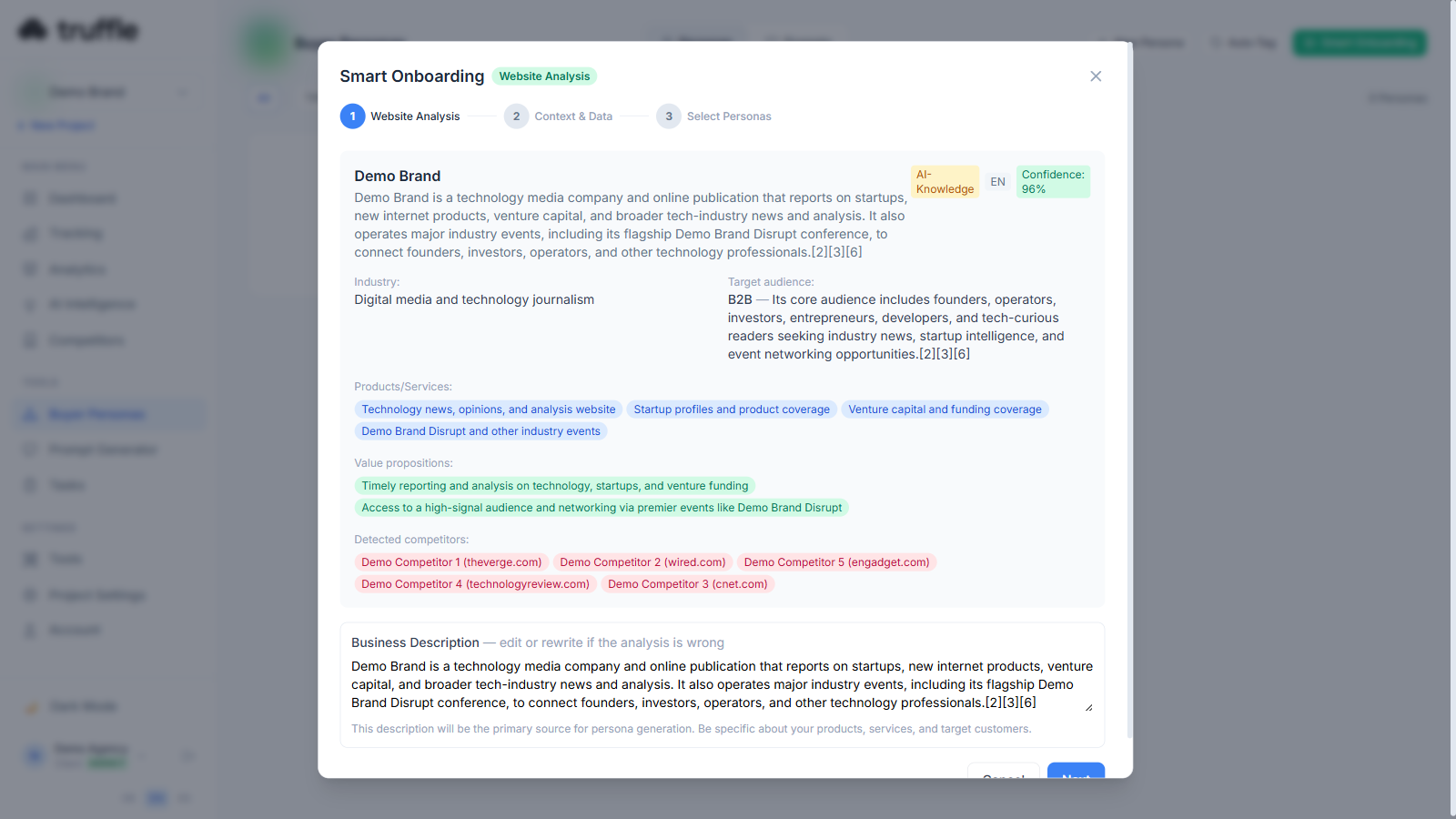
Frequently asked questions
What is Generative Engine Optimization (GEO)?
How is GEO different from SEO?
How is GEO different from AEO?
How is GEO different from LLM SEO?
How do I rank in ChatGPT?
What are the best GEO tools in 2026?
Do I need a GEO agency?
How long does GEO take to show results?
Start with a citation gap audit. Build the program from there.
The Aggarwal paper is the starting model. The six factors above are how the work gets grouped. A 7-day Truffle trial shows you where your brand stands today across every engine.
Used by GEO and SEO agencies serving brands across 12+ countries · GDPR-ready · Encrypted backups · Cancel anytime.